
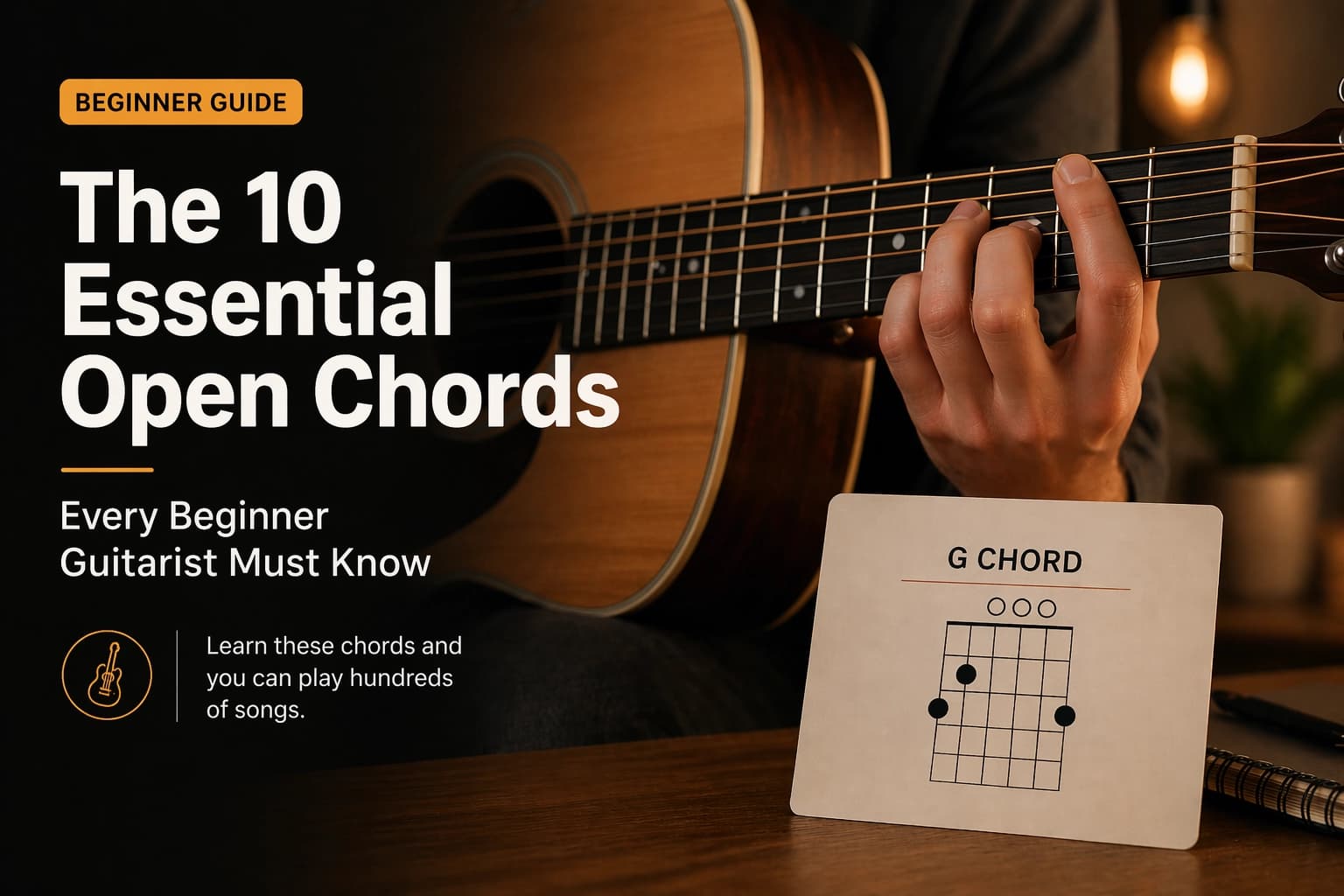
I learned every one of these ten chords the slow, stubborn way — off YouTube, on a cheap laminate guitar I saved six months of bus fare to afford, with absolutely no idea why any of them worked. I just copied the shapes and played until my fingers gave out. It worked. Within a few months I could play real songs, and twelve years of playing later those same ten shapes are still the foundation of almost everything I play.
So this isn't a sterile spec sheet. It's the exact list I wish someone had put in front of me on day one, plus the finger-by-finger positions, the songs each chord unlocks, and the mistakes that cost me time (and a fair amount of finger pain). If you're a complete beginner, start here — and if you're not sure how to read the diagrams yet, grab the guide to reading chord diagrams first.
Why Open Chords First?
Open chords use at least one open (unfretted) string and are played in the first few frets of the guitar. They're easier on the fingers than barre chords, ring out with a natural resonance, and — most importantly — they unlock a huge catalogue of real songs from day one.
That last part is what kept me going. Nothing builds momentum like playing an actual song you recognise in your first week. The 10 chords below cover the major and minor shapes in the most common guitar keys: E, A, D, G, C, and B. Learn these and you'll be able to play hundreds of songs.
How I Learned These Chords (the Hard Way)
I started on the ukulele in elementary school, but in high school I decided I wanted to play guitar — mostly because I thought Bruno Mars looked impossibly cool doing it. My parents didn't think guitar was a useful thing to learn, so there was no budget for one. I saved my allowance for over half a year, spending it on nothing but bus fares, until I scraped together enough for a low-quality laminate acoustic. I was 13, and in my small town, there was no music store to order from — getting that guitar meant a long bus ride to an actual shop.
It was dark red, had a cutaway, and looked great. It also had ridiculously high action up at the 12th fret, so it fought me on every chord. I complained that it felt awful to play; I was told "that's just a regular guitar," and I believed it. It wasn't until much later that I understood a bad setup makes everything harder than it should be.
There was no AI back then, but YouTube was full of song tutorials, so I jumped straight in. I learned basic chords, copied finger placements, and memorized shapes. I could play songs without knowing why a single thing worked — and I loved it. I practiced around five hours a day, even on school nights, until my fingers went numb and my wrists burned. When the pain got bad, I'd dunk my arms in ice water and keep going.
Looking back, that was reckless. I knew nothing about technique, rest, or injury prevention. Please don't copy that part — build calluses gradually, keep your hand relaxed, and stop when something hurts. Sore fingertips are normal; joint or wrist pain is a signal to rest.
The takeaway isn't the ice water — it's that you don't need theory, a good guitar, or a teacher to start. You need these shapes and the patience to repeat them. The ten chords below are exactly what I drilled, in roughly the order they got easier for me.
1. E Major
BeginnerStrings played: All 6 strings
| String | Position |
|---|---|
| String 6 (low E) | Open — played as-is |
| String 5 (A) | Fret 2, finger 2 |
| String 4 (D) | Fret 2, finger 3 |
| String 3 (G) | Fret 1, finger 1 |
| String 2 (B) | Open — played as-is |
| String 1 (high e) | Open — played as-is |
Arch your fingers so the open strings ring clearly. This is one of the most common chords in rock and blues.
2. E Minor
BeginnerStrings played: All 6 strings
| String | Position |
|---|---|
| String 6 (low E) | Open — played as-is |
| String 5 (A) | Fret 2, finger 2 |
| String 4 (D) | Fret 2, finger 3 |
| String 3 (G) | Open — played as-is |
| String 2 (B) | Open — played as-is |
| String 1 (high e) | Open — played as-is |
Em is arguably the easiest chord to learn — only two fingers. It has a dark, melancholy sound that works beautifully in minor-key songs.
3. A Major
BeginnerStrings played: Strings 5–1 (mute string 6)
| String | Position |
|---|---|
| String 6 (low E) | X — muted, do not play |
| String 5 (A) | Open — played as-is |
| String 4 (D) | Fret 2, finger 2 |
| String 3 (G) | Fret 2, finger 3 |
| String 2 (B) | Fret 2, finger 4 |
| String 1 (high e) | Open — played as-is |
Three fingers crowd the same fret — try a slight diagonal angle so each fingertip clears the adjacent string.
4. A Minor
BeginnerStrings played: Strings 5–1 (mute string 6)
| String | Position |
|---|---|
| String 6 (low E) | X — muted, do not play |
| String 5 (A) | Open — played as-is |
| String 4 (D) | Fret 2, finger 2 |
| String 3 (G) | Fret 2, finger 3 |
| String 2 (B) | Fret 1, finger 1 |
| String 1 (high e) | Open — played as-is |
Am is closely related to E major — notice you're using the same shape, just shifted. Recognising these relationships speeds up learning.
5. D Major
BeginnerStrings played: Strings 4–1 (mute strings 6 & 5)
| String | Position |
|---|---|
| String 6 (low E) | X — muted, do not play |
| String 5 (A) | X — muted, do not play |
| String 4 (D) | Open — played as-is |
| String 3 (G) | Fret 2, finger 1 |
| String 2 (B) | Fret 3, finger 3 |
| String 1 (high e) | Fret 2, finger 2 |
Only four strings — keep your strumming arm from accidentally catching the low strings. The diamond shape of fingers takes a little practice to nail cleanly.
6. D Minor
BeginnerStrings played: Strings 4–1 (mute strings 6 & 5)
| String | Position |
|---|---|
| String 6 (low E) | X — muted, do not play |
| String 5 (A) | X — muted, do not play |
| String 4 (D) | Open — played as-is |
| String 3 (G) | Fret 2, finger 2 |
| String 2 (B) | Fret 3, finger 3 |
| String 1 (high e) | Fret 1, finger 1 |
Dm has a distinctive melancholy sound. The transition from D major to D minor is a great exercise — only one finger moves.
7. G Major
EasyStrings played: All 6 strings
| String | Position |
|---|---|
| String 6 (low E) | Fret 3, finger 2 |
| String 5 (A) | Fret 2, finger 1 |
| String 4 (D) | Open — played as-is |
| String 3 (G) | Open — played as-is |
| String 2 (B) | Fret 3, finger 3 |
| String 1 (high e) | Fret 3, finger 4 |
G is a big, resonant chord. Many beginners use fingers 1–2–3 but switching to 2–3–4 makes transitions to C major much smoother.
8. C Major
EasyStrings played: Strings 5–1 (mute string 6)
| String | Position |
|---|---|
| String 6 (low E) | X — muted, do not play |
| String 5 (A) | Fret 3, finger 3 |
| String 4 (D) | Fret 2, finger 2 |
| String 3 (G) | Open — played as-is |
| String 2 (B) | Fret 1, finger 1 |
| String 1 (high e) | Open — played as-is |
C major trips up beginners because fingers need to reach across non-adjacent strings. Slow practice with a metronome is the fastest route to getting it clean.
9. B7
EasyStrings played: Strings 5–1 (mute string 6)
| String | Position |
|---|---|
| String 6 (low E) | X — muted, do not play |
| String 5 (A) | Fret 2, finger 1 |
| String 4 (D) | Fret 1, finger 2 |
| String 3 (G) | Fret 2, finger 3 |
| String 2 (B) | Open — played as-is |
| String 1 (high e) | Fret 2, finger 4 |
B7 is a great introduction to dominant seventh chords — it has a bluesy, tense quality that resolves beautifully to E major. Keep your fretting fingers arched so strings 3 and 1 ring open clearly.
10. G7
EasyStrings played: All 6 strings
| String | Position |
|---|---|
| String 6 (low E) | Fret 3, finger 2 |
| String 5 (A) | Fret 2, finger 1 |
| String 4 (D) | Open — played as-is |
| String 3 (G) | Open — played as-is |
| String 2 (B) | Fret 1, finger 3 |
| String 1 (high e) | Open — played as-is |
G7 is almost identical to G major — only one finger changes. It's the classic dominant seventh that appears constantly in blues, jazz, and country. The tension it creates makes C major feel like a welcome resolution.
Important Barre Chords for Beginners
Once you've got the 10 open chords under your fingers, barre chords are the natural next step. They're harder to play cleanly at first — your index finger needs to press all the strings across a single fret — but the payoff is huge: every barre shape is moveable. Learn one shape, and you unlock every key on the fretboard.
F major was the wall I hit hardest. On my high-action laminate it felt impossible, and it's the chord that had me dunking my arms in ice water more than any other. The fix wasn't more force — it was rolling the index finger slightly toward the headstock and, eventually, switching to lighter strings. If F is fighting you too, you're in good company; it clicks with time.
F Major (E-shape barre)
IntermediateRoot: String 6 (low E), fret 1
The most infamous chord for beginners. Barre all 6 strings at fret 1 with your index finger, then add the E major shape on top with fingers 2–3–4.
Slide this shape up the neck and it becomes F♯, G, A♭, A, B♭… — one shape, every major key.
Press your index finger as close to the fret wire as possible and roll it slightly toward the headstock. This reduces the pressure needed to get all strings ringing cleanly.
B Minor (A-shape barre)
IntermediateRoot: String 5 (A), fret 2
A partial barre across strings 5–1 at fret 2, with fingers 3–4 forming the minor shape on strings 4 and 3. Mute string 6 with the underside of your index finger.
Move to fret 5 → E minor. Fret 7 → F♯ minor. Any minor key is reachable.
This is often easier than a full 6-string barre — your index only needs to press 5 strings. Focus on getting the barre to ring cleanly on strings 5, 2, and 1.
C Major (A-shape barre)
IntermediateRoot: String 5 (A), fret 3
Same barre shape as B minor but shifted up one fret and voiced as a major chord using fingers 2–3–4 on strings 4–3–2. A great progression: C barre → B minor barre → A major.
Fret 2 = B major. Fret 5 = E major. Every major key on one shape.
Many players use a partial barre here — just press strings 5, 2, and 1 with the index finger, letting fingers 2–3–4 handle the middle strings. Less pressure, cleaner sound.
Ready to tackle barre chords?
Use the Chord Diagram Maker to visualise any barre shape up and down the neck before you practice it.
What to Learn Next
Once you can switch between these 10 chords without looking at your hands, you're ready for the next level. Here's a suggested path:
- 1
Practice common progressions like G–D–Em–C and Am–F–C–G until transitions are smooth.
- 2
Add a strumming pattern — even a simple down-up rhythm transforms chord practice into real music.
- 3
Tackle barre chords starting with F major, then move the shape up and down the neck.
- 4
Explore the chord library to discover variations like sus2, sus4, and add9 shapes that add colour to your playing.
Use our Chord Diagram Maker to visualise any new chord you encounter, our Chord Library to browse 800+ shapes across every key, and our Chord Practice tool to build the muscle memory you need to switch between them effortlessly.
Key Takeaways
- Start with the two-finger shapes — E minor and A minor. Getting a clean, buzz-free sound matters far more than speed early on.
- You don't need an expensive guitar or any music theory to learn these. I learned all ten on a cheap laminate guitar with neither.
- Practice the transitions, not just the shapes. Switching between chords cleanly is the real skill — and the one that takes the longest.
- Protect your hands. Lighter strings and relaxed, pain-free technique beat brute force. I pushed through pain the wrong way, and I don't recommend it.
- Barre chords are the next wall. One moveable shape (start with F major) unlocks every key on the neck.
Frequently Asked Questions
Can I hear the chords on this page?
Yes. Every chord below has a Play button — tap it to strum the chord through your speakers and check your own fretting against the correct sound before moving on. Audio loads on your first tap, so the first play may take a second.
Which open chord should I learn first?
Start with E minor — it only needs two fingers and uses all six strings, so it is the easiest chord to get a clean sound from. After that, learn A minor and D major; those three chords alone unlock dozens of songs.
What are the 10 essential open chords for beginners?
The 10 essential open chords are E major, E minor, A major, A minor, D major, D minor, G major, C major, B7, and G7. Together they cover thousands of beginner-friendly songs and form the foundation for nearly every style of guitar playing.
How long does it take to learn all 10 open chords?
Most beginners can play all 10 shapes within 4–8 weeks of daily 10–15 minute practice. Cleanly switching between them takes a bit longer — usually 2–3 months of consistent practice with a metronome or a chord progression player.
Why do my open chords sound buzzy or muted?
Buzzing usually means a finger is not pressing close enough to the fret wire, or another finger is accidentally touching an adjacent string. Pluck each string one at a time — the string that sounds dead or buzzy is the one to fix. Arching your fingers so they land on their tips clears the open strings.
Do I need a good guitar to learn these chords?
No. I learned every one of these on a cheap laminate beginner guitar with high action. A poorly set-up guitar makes things harder than they need to be, but it does not stop you from learning. If fretting feels punishing, switching to lighter-gauge strings is the cheapest fix before you ever consider a new instrument.
All Guitar Tools
Free tools for every stage of your guitar journey.