
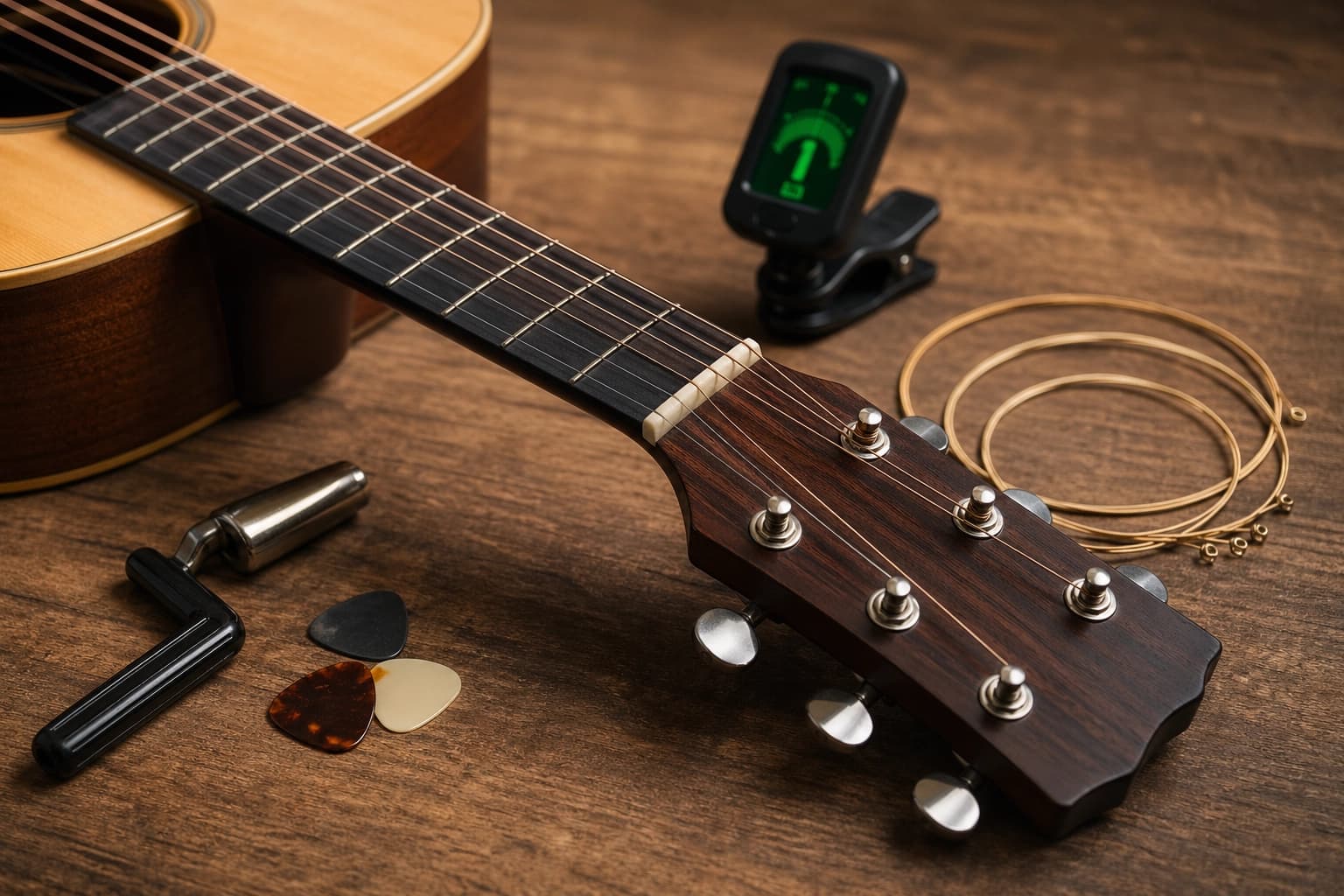
Why Tuning Matters
An out-of-tune guitar will sound wrong no matter how well you play. Notes clash, chords sound muddy, and every mistake is amplified. Tuning is the single most important habit you can build as a guitarist — and it takes less than a minute with a tool like our free online Guitar Tuner.
Beyond standard pitch, tuning also opens a creative door. Different tunings change the way chords are voiced, which strings ring open, and what feels natural to play. Many iconic songs in blues, folk, rock, and metal were written in alternate tunings specifically because those tunings suggested ideas that standard tuning wouldn't.
Standard Tuning (EADGBE)
Standard tuning is the universal starting point. The six strings, from the thickest (lowest pitch) to the thinnest (highest pitch), are tuned to:
Standard tuning — low to high
Mnemonic: Every Amazing Dog Growls Big Echoes
The intervals between strings follow a mostly consistent pattern: each string is tuned a perfect fourth above the one below it (5 semitones), except between the G and B strings, which are a major third apart (4 semitones). This slight quirk is why some chord shapes look irregular on paper but feel natural on the neck.
If you're a beginner, master standard tuning first. Nearly every chord diagram, tab, and instructional resource assumes EADGBE. You can get into standard tuning instantly using our Guitar Tuner.
How to Tune Your Guitar
There are several ways to get in tune. All of them work — choose based on what you have available:
- Clip-on chromatic tuner
- Clamps to the headstock and reads vibrations directly. Works in noisy environments. Most accurate option for beginners.
- Phone tuner app
- Uses your microphone. Free and convenient — GuitarToolHub's browser tuner works the same way without downloading anything.
- Pitch pipe or tuning fork
- Gives you a reference pitch for one string, then you tune the rest by ear using relative tuning.
- By ear (relative tuning)
- Tune each string against the one above it using the 5th-fret method. Useful anywhere, but requires a starting reference pitch.
- Piano or keyboard
- Play the reference note on a piano and match your string to it. Excellent for developing your ear.
The 5th-fret method (relative tuning by ear) works like this: press the 6th string at the 5th fret — it should match the open 5th string (A). Press the 5th string at the 5th fret to match the open 4th string (D), and so on. The only exception is between the 3rd and 2nd strings: fret the 3rd string at the 4th fret (not the 5th) to match the open 2nd string (B).
For speed and accuracy in any environment, a clip-on chromatic tuner or our browser-based Guitar Tuner is hard to beat.
Alternate Tunings Overview
Alternate tunings retune one or more strings away from standard EADGBE. The result is a different harmonic palette — new open chord voicings, different resonances, and in some cases, much simpler fingering for specific styles. Our Guitar Tuner supports all of the tunings below, so you can switch between them in seconds.
They fall into a few broad categories: drop tunings (only the lowest string changes), open tunings (all open strings form a chord), modal tunings (like DADGAD), and pitch-shifted tunings (every string moves by the same amount).
Drop D
Low E → D
Rock, metal, grunge. Instant power chords on the bottom three strings.
Open G
E→D, A→G, high E→D
Blues, slide guitar, classic rock. Used extensively by Keith Richards.
Open D
E→D, G→F♯, B→A, high E→D
Folk, slide, fingerpicking. Full D major chord with open strings.
Open E
A→B, D→E, G→G♯
Blues, slide guitar. Same chord shapes as Open D, one step higher.
Open A
D→E, G→A, B→C♯
Blues, slide guitar. Big, resonant sound for bottleneck playing.
DADGAD
Low E→D, B→A, high E→D
Celtic, folk, fingerstyle. Modal sound — neither major nor minor.
Eb (Half Step Down)
All strings down 1 semitone
Rock. Looser feel, slightly lower vocal range. Hendrix, SRV, Van Halen.
D (Full Step Down)
All strings down 2 semitones
Heavy rock, metal. Heavier feel with same chord shapes as standard.
Drop D Tuning
Drop D is the most widely used alternate tuning and the easiest to get into — you only change one string. Lower the 6th string (low E) by two semitones until it reads D. You can do this quickly using the Guitar Tuner with Drop D selected.
The payoff is immediate: you can now play a power chord on the bottom three strings with just one finger lying flat across them. In standard tuning, power chords require two fingers in an awkward spread. In Drop D, you barre fret 2 and you have an E5 power chord. Barre fret 5 — A5. This is why Drop D is everywhere in rock and metal.
The open D string also lets you add a low root to D chord voicings, giving them a deeper, fuller sound than you get in standard tuning.
Drop D at a glance
Open Tunings (G, D, E, A)
In an open tuning, strumming all six strings without fretting any of them produces a full major chord. This makes them ideal for slide guitar, where a glass or metal slide moves up and down the neck — barring all strings at once — to create smooth, soulful melodies.
Open G (D G D G B D) is one of the most beloved. Keith Richards famously removed his 6th string entirely when playing in Open G, creating the distinctive five-string sound on songs like "Honky Tonk Women" and "Start Me Up." The chord shapes in Open G feel more intuitive for many blues players, and the tuning encourages a rootsy, earthy style.
Open D (D A D F♯ A D) is the folk player's favourite. Joni Mitchell used it extensively, and it's also common in blues and gospel fingerpicking. Many players prefer Open D over Open E because lowering strings (rather than raising them) puts less tension on the neck and strings.
A key thing to know: chord shapes in open tunings are moveable. Whatever chord you play open, barring all six strings at fret 2 gives you the same chord type a whole step higher — making it easy to play major chords all the way up the neck. Use our Guitar Tuner to reach any of these open tunings with real-time pitch feedback.
DADGAD Tuning
DADGAD (pronounced "dad-gad") is a modal tuning — strumming open strings gives you a Dsus4 chord, which is neither clearly major nor minor. This ambiguity is the whole point. The tuning has a hauntingly open, droning quality that suits Celtic and folk music perfectly.
To get to DADGAD from standard, lower your low E string to D, lower the B string to A, and lower the high E string to D. The easiest way is to select DADGAD in our Guitar Tuner and tune each string to the reference tone. Once you're there, you'll find that many traditional Irish and Scottish melodies fall naturally under your fingers along the top two or three strings, while the lower strings provide a rich, sympathetic drone.
Pierre Bensusan, Jimmy Page ("Kashmir"), and countless Celtic fingerstyle players have made DADGAD their primary tuning. It rewards exploration — don't expect to transfer your standard-tuning chord shapes directly. Instead, treat it as a new instrument and discover what it wants to play.
Half Step & Full Step Down
Sometimes you want all the same chord shapes and scale patterns from standard tuning — just shifted lower in pitch. That's exactly what half-step-down (E♭ tuning) and full-step-down (D tuning) give you.
Half step down (E♭ A♭ D♭ G♭ B♭ E♭) is one of the most common choices in rock history. Jimi Hendrix, Stevie Ray Vaughan, and Eddie Van Halen all used it regularly. The strings feel slightly looser and easier to bend, and it puts the guitar a semitone lower — often fitting a vocalist's range better without needing a capo or key change.
Full step down (D G C F A D) goes further. Everything is two semitones lower. Heavy rock and metal bands (Alice in Chains, Soundgarden) used it for a darker, weightier tone. Like half-step-down, all your existing chord shapes and tabs work identically — they just sound lower.
Note that these are different from Drop D: in pitch-shifted tunings, every string moves by the same interval, so nothing about the relative string relationships changes. Both are available in our Guitar Tuner alongside Drop D and all the other tunings covered in this guide.
Tuning Tips & Common Mistakes
- 1
Always tune up to pitch, not down. If a string is sharp, loosen it below the target note, then tune upward. Strings hold pitch better when tension is increasing.
- 2
Re-check after changing all strings. Adjusting one string can slightly affect the others — especially on guitars with a floating tremolo bridge.
- 3
New strings go out of tune quickly. Stretch them in by gently pulling each string away from the body after tuning, then retune. Repeat two or three times.
- 4
Tune before every session. Temperature and humidity changes cause wood and strings to shift overnight — even a guitar in a case.
- 5
Intonation is separate from open tuning. If your guitar is in tune open but chords go sharp higher up the neck, that's an intonation problem — not a tuning problem. It needs a setup.
- 6
When switching to alternate tunings, tune slowly. Drastic changes put stress on the neck. Go string by string and monitor the others as you go.
When in doubt, run through each string again in our Guitar Tuner — the cents deviation display makes it easy to spot strings that are close but not quite there.
Use the Guitar Tuner
The fastest way to get in tune is to use our Guitar Tuner — it runs entirely in your browser with no download required. Just allow microphone access, select your target tuning (standard or any of the alternates above), and pluck each string. The tuner shows you whether you're flat, sharp, or spot on in real time.
It supports standard EADGBE, Drop D, half-step-down, full-step-down, and several open tunings — so you can jump between tunings without reaching for a separate app.
Open the Guitar Tuner →Keep going
All Guitar Tools
Free tools for every stage of your guitar journey.