
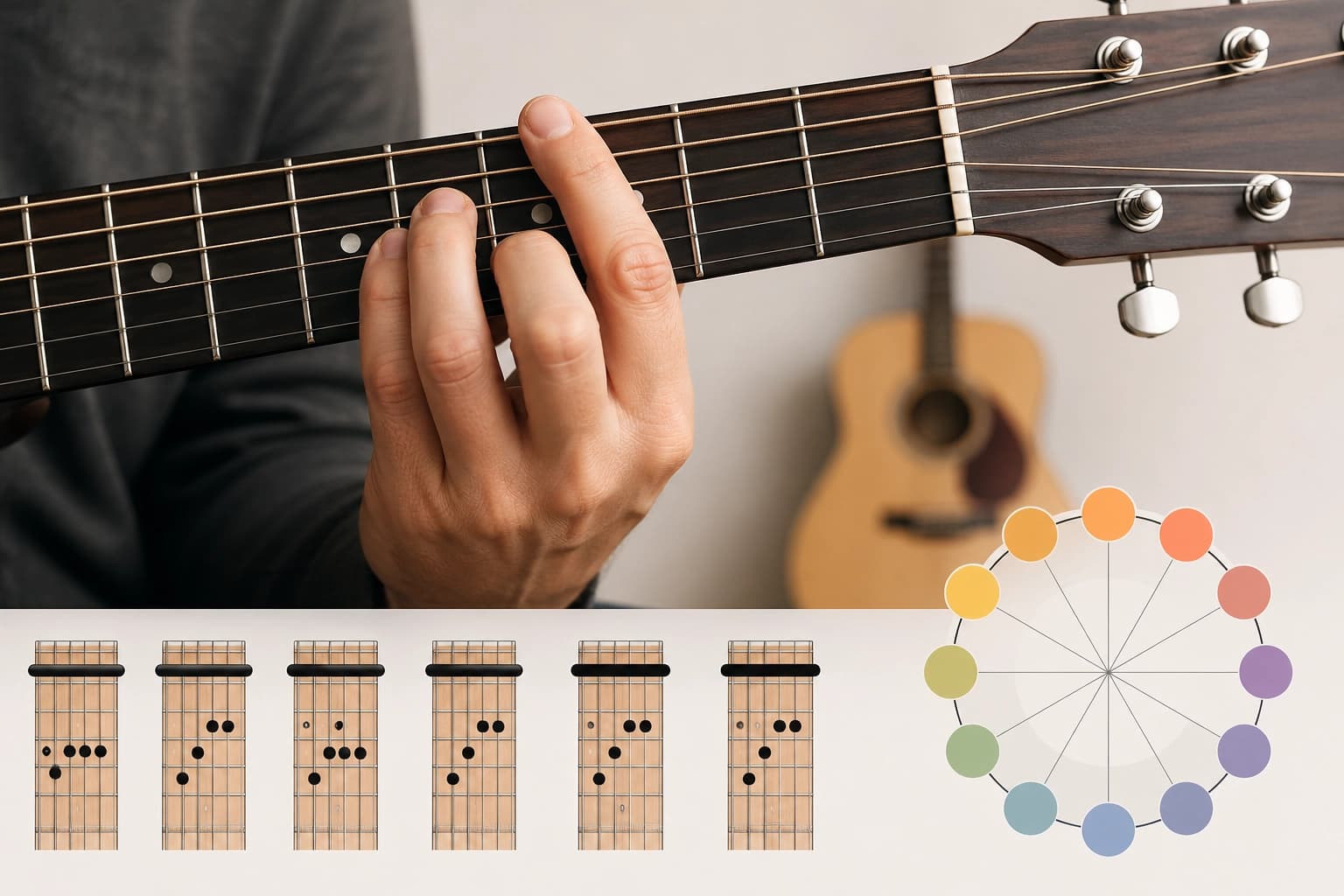
What Are Barre Chords?
A barre chord (also spelled "bar chord") is played by laying your index finger flat across all or most of the strings at a single fret, acting as a moveable capo. Your remaining fingers then form a chord shape on top. Because the whole shape slides up and down the neck, every barre chord is moveable — learn one shape and you unlock that chord in every key without learning new fingerings.
There are two fundamental barre shapes every guitarist needs: the E-shape (rooted on string 6) and the A-shape (rooted on string 5). Together they cover every major and minor chord across the entire fretboard. If you haven't learned open chords yet, start with our guide to the 10 essential open chords first — barre chords will come much faster once those are solid.
Why F Major Feels Impossible (At First)
F major is the first barre chord most guitarists encounter, and it's notorious for a reason: it sits at fret 1, which is actually the hardest position on the neck. The string tension is highest near the nut, which means your index finger has to work harder there than anywhere else. Move that same shape to fret 5, and it suddenly feels easy — not because you got stronger, but because the tension dropped.
Here's what makes fret 1 specifically tough:
- 1String tension is highest closest to the nut — your index finger fights more resistance at fret 1 than any other position.
- 2The classic E major shape on top demands that fingers 2, 3, and 4 work independently while your index is already under strain.
- 3Calluses and hand strength take weeks to build — buzzing for the first month is completely normal.
- 4Most beginners press in the wrong spot or use inefficient thumb placement, making it unnecessarily hard.
The good news: every difficulty above is solvable with the right technique, not just more practice time.
F Major: Step-by-Step Finger Placement
The F major barre chord uses the E major open chord shape shifted up one fret, with your index finger laying across all 6 strings at fret 1.
Strings played: All 6 strings
| String | Position |
|---|---|
| String 6 (low E) | Fret 1, index finger (barre) |
| String 5 (A) | Fret 3, ring finger |
| String 4 (D) | Fret 3, pinky |
| String 3 (G) | Fret 2, middle finger |
| String 2 (B) | Fret 1, index finger (barre) |
| String 1 (high e) | Fret 1, index finger (barre) |
Place your index finger first and get it ringing cleanly before adding fingers 2, 3, and 4. It's easier to build the chord from the barre up than to fix buzzing after all fingers are down.
The moveable payoff
Slide this entire shape up one fret and you have F♯. Two frets up: G. Five frets up: A. The same fingering works for every major chord — you never have to learn a new shape.
5 Technique Fixes That Actually Work
These five adjustments fix the most common barre chord problems. Work through them in order — most players clean up their F major within a single session after applying tip #1 and #2.
Press as close to the fret wire as possible
The closer your index finger is to the metal fret, the less pressure you need for a clean note. Most beginners press in the middle of the fret space — slide your finger forward until it's right behind the wire.
Roll your index finger slightly toward the headstock
The underside of your index finger has a small bony ridge. Rolling toward it — away from the soft fingertip pad — gives a firmer surface across all strings. This single adjustment fixes buzzing for many players immediately.
Keep your thumb behind your middle finger
Your thumb should sit directly behind your index and middle fingers on the back of the neck — not gripping over the top. This position leverages your forearm muscles and removes the need to over-squeeze.
Lean the guitar into your body slightly
You don't need pure grip strength — you need leverage. Tilt the guitar body slightly toward you and let your fretting elbow fall naturally downward. This transfers body weight through the chord instead of relying on hand tension alone.
Build the barre from the high strings first
Start by barring just strings 1 and 2 at fret 1 and getting them to ring cleanly. Then add string 3, then string 6 last. Once you can nail each string in isolation, the full barre feels far less daunting.
The E-Shape Across All 12 Keys
Every major chord in the chromatic scale has a corresponding fret position for the E-shape barre. The root note is always on string 6 (low E) at the barre fret. Memorise this table and you'll never be lost when a song calls for an unfamiliar major chord.
| Fret (index barre) | Chord |
|---|---|
| Fret 1F major | F major |
| Fret 2 | F♯/ G♭ major |
| Fret 3 | G major |
| Fret 4 | G♯/ A♭ major |
| Fret 5 | A major |
| Fret 6 | A♯/ B♭ major |
| Fret 7 | B major |
| Fret 8 | C major |
| Fret 9 | C♯/ D♭ major |
| Fret 10 | D major |
| Fret 11 | D♯/ E♭ major |
| Fret 12 | E major |
Practice F major at fret 1, then slide the shape up to fret 5 (A major) — it rings cleanly with almost no effort. This shows you that the shape itself is already correct; fret 1 just needs more time and callus.
The A-Shape Barre Chord
The A-shape barre uses the A major open chord shape moved up the neck, with the root note on string 5 (A string). String 6 is always muted. The example below is B♭ major (fret 1) — slide it up and every major chord becomes accessible from the A string.
Most players barre strings 4, 3, and 2 together with the ring finger at the third fret of the shape, while the index finger holds the barre. This "ring finger barre" is the most reliable approach for beginners.
Example: B♭ major — Strings played: Strings 5–1 (mute string 6)
| String | Position |
|---|---|
| String 6 (low E) | X — muted, do not play |
| String 5 (A) | Fret 1, index finger (barre — root) |
| String 4 (D) | Fret 3, ring finger (barre across 4–2) |
| String 3 (G) | Fret 3, ring finger (barre across 4–2) |
| String 2 (B) | Fret 3, ring finger (barre across 4–2) |
| String 1 (high e) | Fret 1, index finger (barre) |
Muting string 6 with the tip of your index finger (letting it lightly touch without pressing) is cleaner than trying to avoid it with your strum. Use the A-shape reference table below to find every major key.
| Fret (index barre) | Chord |
|---|---|
| Fret 1 | A♯/ B♭ major |
| Fret 2 | B major |
| Fret 3 | C major |
| Fret 4 | C♯/ D♭ major |
| Fret 5 | D major |
| Fret 6 | D♯/ E♭ major |
| Fret 7 | E major |
| Fret 8 | F major |
| Fret 9 | F♯/ G♭ major |
| Fret 10 | G major |
| Fret 11 | G♯/ A♭ major |
| Fret 12 | A major |
Minor Barre Shapes
Both the E-shape and A-shape have minor variants. The minor shapes use the same barre mechanic — only the chord shape on top changes. Here are the two most important ones.
F Minor (E-shape minor, fret 1)
IntermediateThe E-shape minor barre removes the middle finger from the E major shape — your index barre handles strings 6, 3, 2, and 1, while ring and pinky sit on strings 5 and 4. It has a darker, more intense sound than F major.
| String | Position |
|---|---|
| String 6 (low E) | Fret 1, index finger (barre) |
| String 5 (A) | Fret 3, ring finger |
| String 4 (D) | Fret 3, pinky |
| String 3 (G) | Fret 1, index finger (barre) |
| String 2 (B) | Fret 1, index finger (barre) |
| String 1 (high e) | Fret 1, index finger (barre) |
Slide up: fret 3 = G minor, fret 5 = A minor, fret 8 = C minor. One shape, every minor key.
B Minor (A-shape minor, fret 2)
IntermediateB minor is one of the most common chords in popular music and makes a great entry point into A-shape barre chords — fret 2 is slightly easier than fret 1. The shape is more independent than the ring-barre major version, with fingers 2, 3, and 4 each holding their own string.
| String | Position |
|---|---|
| String 6 (low E) | X — muted, do not play |
| String 5 (A) | Fret 2, index finger (barre — root) |
| String 4 (D) | Fret 4, ring finger |
| String 3 (G) | Fret 4, pinky |
| String 2 (B) | Fret 3, middle finger |
| String 1 (high e) | Fret 2, index finger (barre) |
Fret 5 = D minor, fret 7 = E minor, fret 10 = G minor. Heard in Wonderwall, Shallow, and hundreds more.
Your Barre Chord Practice Routine
Consistency beats duration. Ten focused minutes every day will get you a clean F major faster than an hour of frustrated grinding twice a week. Follow this routine in order — each step builds on the one before it.
- 1
Press-and-release drill: hold the full F major barre for 10 seconds, release completely, and repeat 5 times. No strumming — just check that all 6 strings ring clean.
- 2
String-by-string check: pluck each string individually from low E to high e. Adjust your index finger or any fretting finger that causes a buzz before moving on.
- 3
Slow switch: alternate between Am and F major, one chord every 2 beats at 60 BPM. Aim for every string to ring clearly on the landing.
- 4
Progression drill: play G → D → Em → F over and over for 5 minutes. This progression appears in hundreds of popular songs and forces a real-world F major transition.
- 5
Bump the tempo: once transitions are clean at 60 BPM, move to 70, then 80. Never speed up until the slower tempo sounds right.
- 6
Chord Practice tool: set F major and Am as your target chords with 30-second timed rounds. The built-in rest timer keeps the session structured.
Ready to practice?
All Guitar Tools
Free tools for every stage of your guitar journey.