
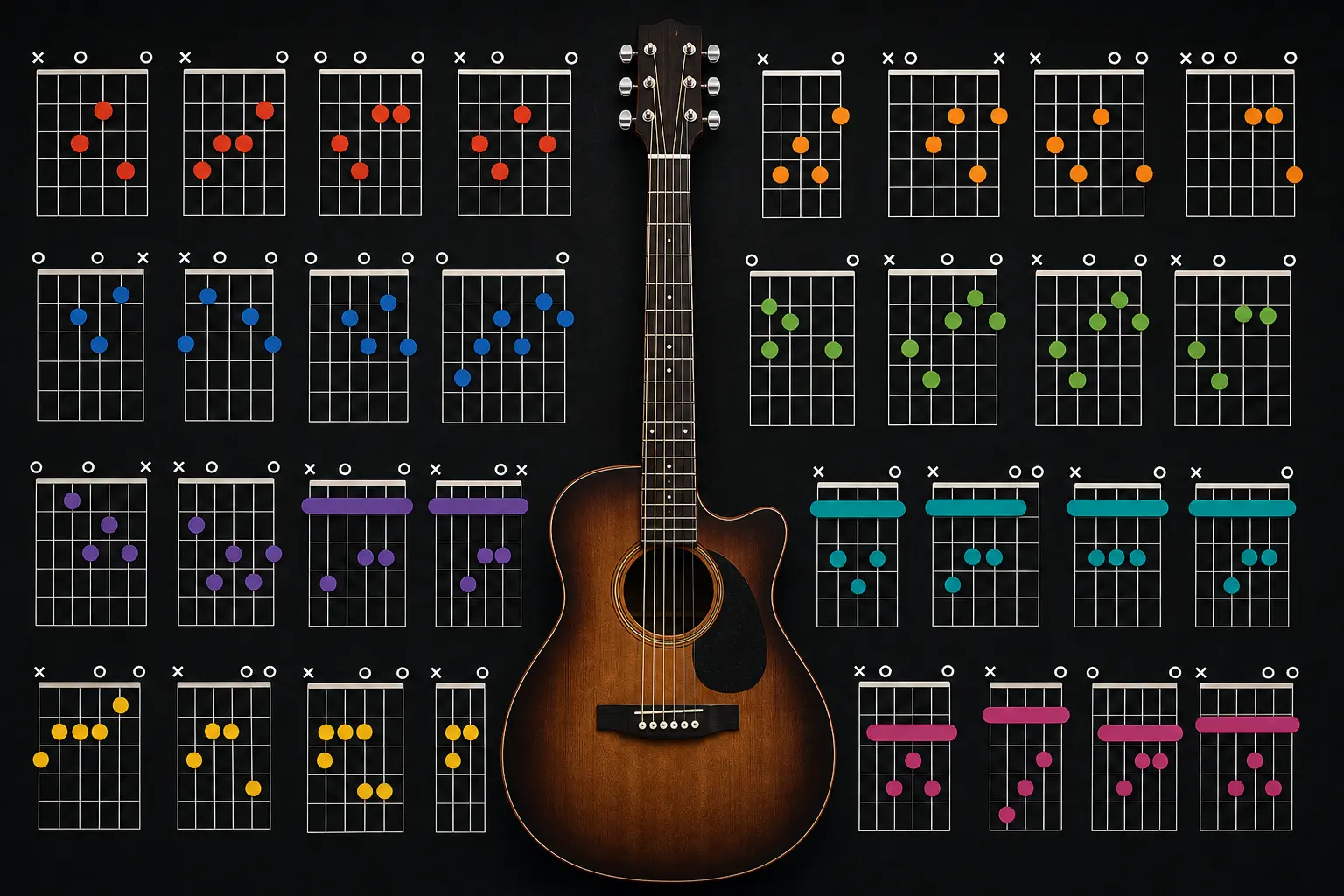
What Is a Guitar Chord Chart?
A guitar chord chart is a reference that shows you how to finger every chord shape on the guitar neck. Rather than written notes on a musical staff, it uses a visual grid — the fretboard — so you can see exactly where to place each finger without needing to read sheet music.
Chord charts come in two forms: individual chord diagrams that show a single shape, and chart sheets that group many chords together for quick reference. Both use the same visual language: six vertical lines for strings, horizontal lines for frets, and filled dots for where your fingers go.
This guide covers every major chord type you'll encounter — from your first open chords to barre shapes, power chords, and extended voicings. At the bottom you'll find the interactive Chord Library with over 800 diagrams you can search and filter by type, key, or chord name.
How to Read Chord Diagrams
Every chord diagram follows the same layout. Once you understand the visual grammar, you can pick up any chord shape in seconds — no musical training required.
Diagram key
Filled dot
Press here — the number inside is the suggested finger
X above string
Do not play this string — mute or avoid it
O above string
Play this string open — no finger needed
Curved bar line
Barre: lay your index finger flat across all these strings
Fret marker
The diagram starts at fret 5, not fret 1
Finger numbers
1 = index, 2 = middle, 3 = ring, 4 = pinky
Strings run left to right: low E (thickest) on the left, high e (thinnest) on the right. Frets run top to bottom: nut at the top, body of the guitar below.
When a diagram shows a fret number in the top-right corner (like "5fr"), it means the pattern starts further up the neck. Everything shifts up by that amount — the shapes themselves stay the same.
For a more detailed walkthrough with examples, see the full How to Read a Guitar Chord Diagram guide.
Open Chords
Open chords are the foundation of every beginner's vocabulary — and they stay in regular use at every level. They use at least one open (unfretted) string, which adds resonance and sustain that closed shapes can't replicate. Most open chords sit in the first three frets, making them physically accessible early on.
0,2,2,1,0,0
Anchor finger 1 on the G string — the other two fall naturally.
0,0,0,2,2,0
The easiest chord on the guitar. Two fingers, full open strum.
–,0,2,2,2,0
Keep fingers vertical — they need to fit on fret 2 without muting the high e.
–,0,1,2,2,0
Same shape as A major but with finger 1 on the B string instead.
–,–,2,3,2,0
Strum only the top 4 strings. The bottom two strings are muted.
–,–,1,3,2,0
D minor and D major share the same string set — just move finger 1 down.
3,0,0,0,2,3
The "full" G shape rings the richest — all 6 strings, three finger corners.
–,3,1,0,2,0
The stacked fingering can be tricky at first — practice the landing as one motion.
The fret numbers in the table above are string values written low E → high e (e.g., D major: x,x,0,2,3,2). Use these with a chord diagram to confirm exact finger placement.
Master G, C, D, Em, and Am first — they form the backbone of hundreds of songs across pop, rock, folk, and country. The full set of 10 essential open chords is covered in the dedicated Open Chords guide.
Barre Chords
A barre chord uses the index finger to press all six strings at one fret, acting as a moveable nut. The remaining fingers form a chord shape above. Because the shape stays the same no matter where it sits on the neck, one barre shape gives you a chord in every key.
There are two main barre chord families:
E-shape barre chord
Root: Root on low E string
Examples: F major = E shape at fret 1, B major = E shape at fret 7
The most common barre chord family. F major (fret 1) is the first barre chord most players tackle.
A-shape barre chord
Root: Root on A string
Examples: B major = A shape at fret 2, C major = A shape at fret 3
Second most common family. Reach these by moving the A major open chord shape up the neck with a barre.
Struggling with F major? The most common issue is index finger position, not finger strength. See the full Barre Chords guide for a technique breakdown with five specific fixes.
Power Chords
Power chords are two-note shapes — just the root and the 5th, no 3rd. Because there's no major or minor quality, they work under heavy distortion without the harmonic clash that full chords produce. They're the building block of rock, punk, and metal rhythm playing.
Two main power chord shapes
6th-string root (e.g. E5)
Low E: root · A: +2 frets · D: +2 frets
Three-string version — adds the octave root on the D string for a fuller sound.
5th-string root (e.g. A5)
A: root · D: +2 frets · G: +2 frets
Same shape, one string set lower. Mute the low E string with the side of your thumb.
To find any power chord: locate the root note on the low E or A string, place your index finger there, and stretch fingers 3 and 4 two frets higher on the next two strings. That's the complete shape — every power chord follows the same pattern.
Minor Chords
Minor chords have a lowered (flattened) 3rd compared to their major counterparts. That single semitone change shifts the emotional quality from bright and stable to darker and more introspective. Every major chord has a direct minor equivalent — same root, same strings, one note moved.
Remove fingers from G and D strings — two open strings replace two fretted notes.
Drop the note on the B string from fret 2 to fret 1 (index finger moves down).
Move the note on the high e string from fret 2 to fret 1.
Barre chord shape — minor barre uses the Em shape instead of the E major shape.
Barre chord at fret 3 — the Am barre shape gives you Cm and every other minor key.
For open minor chords, the three you'll use most often are E minor, A minor, and D minor. For barre minor chords, the Em-shape barre and Am-shape barre cover every other minor key as you move them up the neck.
7th & Extended Chords
7th chords add a fourth note on top of the basic triad. That extra note introduces harmonic colour and tension — from the bluesy growl of a dominant 7th to the dreamy shimmer of a major 7th. Extended chords add even more: 9ths, 11ths, and 13ths layer more notes on top, pulling the sound toward jazz and soul.
G7
Dominant 7th
Open shape — remove the pinky from G major and add index to high e string fret 1.
D7
Dominant 7th
Open shape — same fret area as D major, with the index moving to the B string.
E7
Dominant 7th
E major with the G string open — easiest 7th chord to learn.
Amaj7
Major 7th
A major with the G string open — produces the dreamy, floating major 7th quality.
Em7
Minor 7th
E minor with the B string added at fret 3 — smooth and easy to grab.
Dm7
Minor 7th
D minor with the high e string moved to fret 1 — common in jazz and soul progressions.
Start with the open dominant 7th chords — G7, D7, and E7 — since they appear constantly in blues and folk. Once those feel natural, add the major 7th and minor 7th shapes to your vocabulary.
Chord Types Explained
Every chord name tells you two things: the root note (the letter) and the chord type (everything after). Here's a complete reference for every chord type you'll encounter:
The formula column uses interval numbers: 1 = root, 3 = major 3rd, b3 = flat 3rd, 5 = perfect 5th, b5 = flat 5th, #5 = sharp 5th, 7 = major 7th, b7 = flat 7th. These intervals are measured from the root and stay consistent regardless of the key you're in.
Browse 800+ Chord Diagrams
The Guitar Tool Hub Chord Library contains over 800 chord diagrams spanning all 12 root notes and every major chord type — major, minor, 7th, maj7, m7, dim, aug, sus4, sus2, power, sixth, and add9.
What's inside the library
12 root notes
C, C#, D, D#, E, F, F#, G, G#, A, A#, B — every key covered.
Multiple voicings
Each chord includes open, barre, and upper-neck voicings where available.
Filter by type
Show only 7th chords, only sus chords, only power chords — instantly.
Search by name
Type "Cmaj7" or "F#m" and get every matching diagram.
Full chord pages
Each chord links to a dedicated page with full diagrams, notes, and context.
No sign-up required
Everything is free, browser-based, and works on mobile.
Practice Tips
Having a complete chord reference is one thing — building the muscle memory to play those chords cleanly is another. These practice principles apply regardless of whether you're working on your first G chord or a jazz voicing:
- 1
Practice chord transitions, not just shapes. The moment between chords is where most players lose time — drill the switch from one specific chord to another, not the chord itself.
- 2
Use a metronome and keep it slow. A clean change at 60 bpm is worth far more than a sloppy one at 120. Speed comes automatically once the movement pattern is locked in.
- 3
Check each string individually. After pressing a chord, pick each string one at a time and listen for muted or buzzing notes. Fix the cause, not just the symptom.
- 4
Learn chords in context. Plug new shapes into a chord progression you already know. Hearing how the new chord sounds in a sequence is the fastest way to internalize it.
- 5
Group shapes by hand position. Instead of learning random chords, learn the barre chord family together, then the open chord family. Shared hand positions reduce the mental load.
- 6
Use the chord library as a lookup, not just a study list. When you encounter an unfamiliar chord in a song, find it in the library and spend five minutes on just that shape before moving on.
The biggest mistake guitarists make with chords is learning shapes in isolation. Chords only matter when they connect to other chords — so practice them as pairs and groups from the start.
Suggested progression for chord library use
Week 1–2: G – C – D – Em (the most common four-chord sequence in pop and rock)
Week 3–4: Add Am and F major — unlocks a major-to-minor layer in progressions
Month 2: E-shape and A-shape barre chords — one shape covers every key
Month 3+: 7th and extended chords — add colour on top of the shapes you already know
Keep going
All Guitar Tools
Free tools for every stage of your guitar journey.