
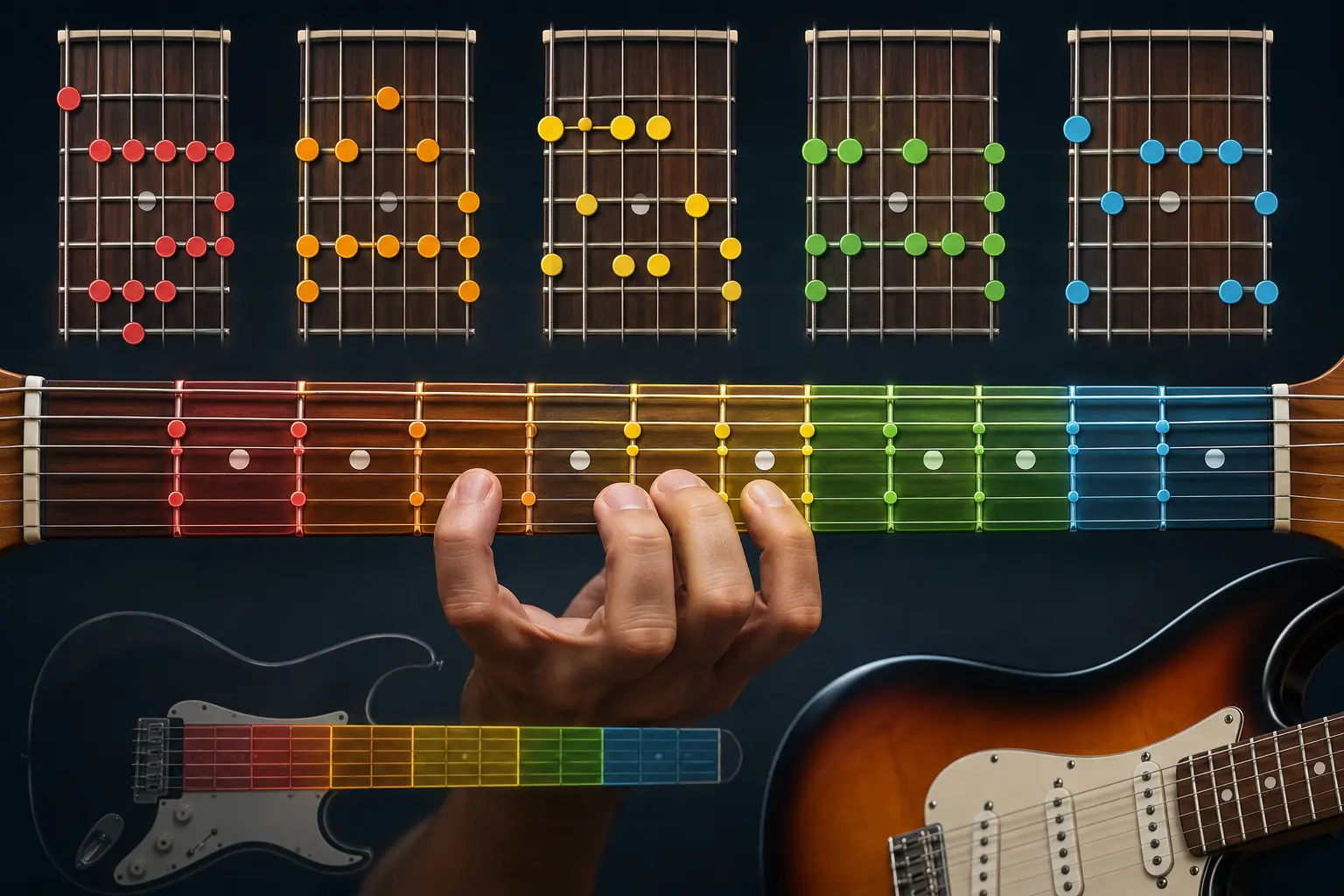
What Is the CAGED System?
The CAGED system is a way of seeing the entire guitar fretboard using five chord shapes you almost certainly already know: the open C, A, G, E, and D major shapes. Spell those five letters out and you get the name — CAGED.
Here's the big idea. Those five open shapes aren't stuck down at the nut. Each one is movable — slide it up the neck (turning the open strings into a barre) and it becomes the same type of chord in a new key. Because the five shapes interlock in a fixed order, they tile the whole fretboard, so you can play any chord in five different places and always know where the next shape begins.
Learn this and the neck stops feeling like a random grid of dots. CAGED gives you a map: a way to connect chords, find the right scale around any chord, and stop being trapped in one box at the 5th fret. Below you can tap each shape to hear it, then see how they link together.
The 5 CAGED Shapes
These are the five anchor shapes in their open (home) position. Tap Hear it on any diagram to play the chord on a real sampled guitar. The highlighted dot is the root note — the note that names the chord and the note you track as you move the shape up the neck.
Root on the A string. The trickiest shape to move as a barre, but it sits high and bright and links the E and A shapes together.
Root on the A string. Becomes the classic A-form barre chord (think B or C# barred at the 2nd and 4th frets).
Root on the low E string. Awkward to barre, but as a movable shape it ties the whole system together between the E and D shapes.
Root on the low E string. The most useful movable shape on the guitar — barre it and you have F, G, A and every other major chord.
Root on the D string. Small and high — only the top four strings ring. Great for adding sparkle higher up the neck.
Why these five? They're the only major shapes with open strings, which means each one has a unique fingering that can be barred and moved. There's no “B shape” or “F shape” because those are just the A shape and E shape moved up — already covered by the five.
How the Shapes Connect Across the Neck
The shapes always appear in the same repeating order as you move up the neck: C → A → G → E → D, then back to C and around again. Pick any key and its five shapes link together like jigsaw pieces — the top of one shape is the bottom of the next.
Take C major. It starts with the open C shape at the nut. Slide up and the next voicing of C is the A shape (barred around the 3rd fret), then the G shape (5th), the E shape (8th), and the D shape (10th) — before the C shape returns an octave higher at the 12th fret. Five shapes, one chord, the whole neck covered.
The order never changes
C-A-G-E-D is a loop. Whatever shape you're playing, the next shape up the neck is always the next letter in CAGED, and the one below is the previous letter. Memorising that single sequence is what lets you navigate the fretboard without getting lost.
Seeing this in motion is far easier than reading it. The CAGED System Visualizer steps you through all five shapes connecting across the neck in any key, with the roots highlighted so the pattern clicks.
What the CAGED System Unlocks
Play Any Chord in Five Places
Stuck playing every chord down at the first few frets? CAGED gives you five voicings of the same chord spread across the neck, so you can pick the one that sounds best or sits closest to where your hand already is.
Escape the “One Box” Trap
Most players learn one pentatonic box and never leave it. Each CAGED shape has a scale pattern that wraps around it, so once you know which shape you're in, you instantly know which scale notes are under your fingers. Connect the shapes and you can solo across the entire neck instead of one five-fret island. The Guitar Scales Visualizer shows exactly which notes surround each shape.
See Chords and Scales as One Thing
CAGED's real payoff is that it ties chords and scales together. The chord shape is just the “home base” notes inside the surrounding scale — so arpeggios, chord tones, and licks all line up with a shape you already recognise. That's the foundation of melodic, chord-aware soloing.
Find Notes Faster
Because every shape has its root on a known string, CAGED doubles as a fretboard map. Track the roots and you always know what note — and what chord — you're on. Drilling the raw notes with the Fretboard Note Trainer makes this second nature.
How to Practice the CAGED System
Don't rush to learn all five shapes at once. Two shapes you can connect smoothly are worth more than five you can only play in isolation.
Common CAGED Mistakes to Avoid
Memorising Shapes Without the Roots
The shapes are useless if you don't know what note you're playing. Always anchor each shape to its root — that's what turns a finger pattern into an actual chord you can name and use.
Thinking CAGED Is Only for Chords
Many players learn the five chord shapes and stop there, missing the whole point. The system's power is connecting those chord shapes to the scales around them. Skip the scale step and you've only learned half of CAGED.
Trying to Learn All Five at Once
Five shapes, five scale patterns, twelve keys — dumped in at once, it's overwhelming. Master one shape and its neighbours first. The map fills in faster when you build it piece by piece.
Treating the G and C Shapes as Barre Chords
The C and G shapes are awkward to play as full barre chords — even pros rarely do. Use them mostly as map markers and partial voicings (grab three or four strings), and lean on the easier E, A, and D forms for full chords.
See It on the Fretboard
The CAGED system turns the fretboard from a wall of dots into five familiar shapes that connect in a fixed, repeating order. Learn the five shapes, anchor each to its root, link them up the neck, then add the surrounding scales — and you'll never feel lost above the 5th fret again.
CAGED is a visual system, so the fastest way to make it click is to watch the shapes connect. Open the visualizer, pick a key, and step through C → A → G → E → D as they tile across the neck.
Open the CAGED System Visualizer →Keep exploring the neck
All Guitar Tools
Free tools for every stage of your guitar journey.