
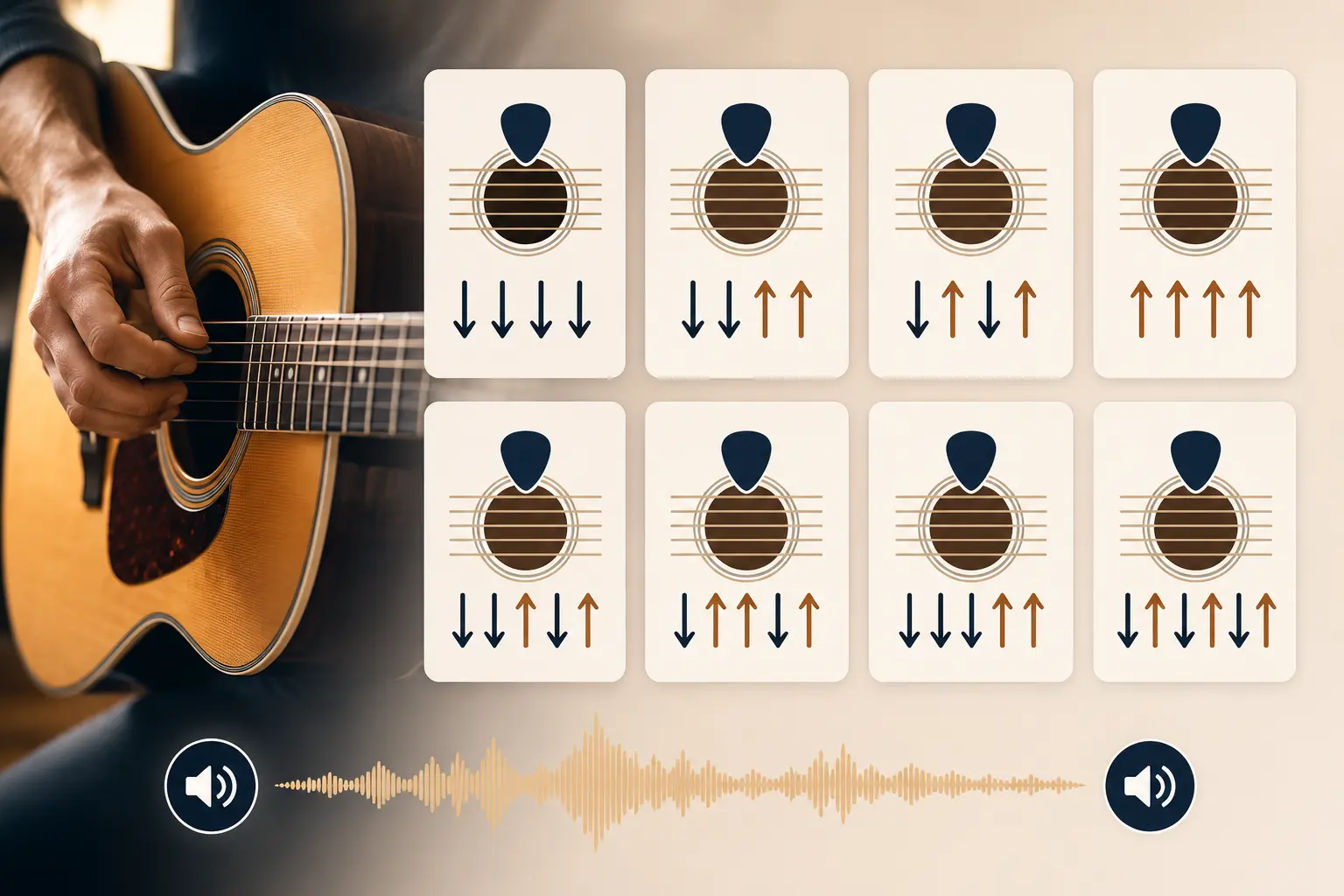
Why Strumming Patterns Matter
Most beginners pour weeks into learning chords, then wonder why their playing still doesn't sound like a real song. The missing piece is almost always the right hand. Chords are the what; the guitar strumming pattern is the feel — it's the difference between a flat, robotic chord change and something that grooves.
The good news: you don't need dozens of strumming patterns. A handful of versatile rhythms — the strumming styles you'll hear in pop, rock, folk, country, and worship — covers the overwhelming majority of popular songs. Master the eight below and you can confidently strum through thousands of them.
Every pattern on this page is playable — hit the play button and you'll hear it strummed on a real sampled G chord at the tempo you choose, with the beat lighting up as it goes. When you want to drill them hands-on, the Strumming Practice tool takes it further with animated up/down guides.
How to Read a Strumming Pattern
Strumming patterns are written using two simple symbols across one bar of 4/4 time, which you count as “1 & 2 & 3 & 4 &” (eight evenly spaced moments):
- ↓ (D)A downstroke — drag the pick down across the strings, from the low E toward the high E.
- ↑ (U)An upstroke — brush back up, usually catching only the top 3–4 strings.
- · (rest)No strum. But your hand keeps moving — you just miss the strings. This is the secret to staying in time.
Counting out loud is the fastest way to get a rhythm into your body, and saying it as syllables works even better — it turns an abstract pattern into something you can already pronounce. FaChords’ Rhythmic Dictation Trainer builds rhythms out of ordinary words and loops them against a click, which makes a good warm-up before you pick up the guitar for the patterns below.
The golden rule of strumming: your strumming hand never stops moving. It swings down on every beat and up on every “&”, like a metronome arm. On a rest, you simply let it pass over the strings without touching them. Keep that constant motion and your timing fixes itself.
8 Essential Strumming Patterns
Work through these roughly in order — each one builds on the motion of the last. Press play to hear any pattern, count out loud (“1 & 2 & 3 & 4 &”) along with the highlighted beat, then pick up your guitar and match it. Start slow and only speed up once the pattern feels automatic.
1. Four Downstrokes
One downstroke on each beat. The foundation — get this locked to a metronome before anything else. Used in countless slow rock and pop songs.
2. Continuous Eighths (Down-Up)
A down on every beat and an up on every "&". Keep your strumming hand moving like a pendulum — this constant motion is the engine behind every pattern below.
3. "Old Faithful" (D – D U – U D U)
The single most common acoustic pattern — it fits a huge slice of pop, folk, and worship songs. The trick: keep your hand swinging through the rests, just miss the strings.
4. Folk / Country
Old Faithful with the gap filled in after beat 2. A busy, driving feel that suits campfire singalongs and up-tempo country.
5. Pop Ballad
Sparser and more syncopated — leaves space on beat 2 so the upstrokes pull against the pulse. Great for emotive, mid-tempo songs.
6. Reggae Skank (offbeats)
Strum only the "&" of each beat with short, muted upstrokes. Mute the strings the instant after you hit them for that clipped reggae and ska "chk".
7. Punk / Rock Downstrokes
All downstrokes, all eighth notes. Demanding on the wrist but it delivers the relentless, aggressive drive of punk and hard rock. Build the stamina slowly.
8. Slow Ballad (half-time)
Wide open and patient — a down on beats 1 and 3 with a little D-U lift at the end of the bar. Lets big, ringing chords breathe in 6/8-flavored and slow 4/4 ballads.
Want the animated, full-screen version with more patterns and a built-in metronome click? Open the Strumming Practice tool and drill each one until it's second nature.
Strumming Technique Tips
Keep Your Wrist Loose
Strumming comes from the wrist, not the elbow or the whole arm. Imagine shaking water off your hand — that loose, relaxed flick is the motion you want. A stiff, locked wrist makes everything sound harsh and tires you out fast.
Strum From a Constant Pendulum
Don't think of individual strums — think of one continuous down-up motion that never stops. Your hand is always travelling down on the beats and up on the offbeats; the pattern just decides which of those passes actually hit the strings.
Go Easy on the Pressure
You don't need to dig in hard. A light, glancing stroke that catches the strings cleanly sounds far better than a heavy one that yanks the guitar out of tune. Downstrokes can hit all six strings; upstrokes usually only need the top three or four.
Lock It to a Click
Timing is everything in rhythm playing. Run a metronome or a drum track underneath every pattern. If you can only nail it without a click, you don't own it yet.
A 15-Minute Practice Routine
Fifteen focused minutes a day beats an hour of aimless strumming once a week. Consistency is what turns these patterns into muscle memory.
Common Mistakes to Avoid
Stopping Your Hand on the Rests
The most common beginner error. If your hand freezes every time there's no strum, your timing collapses. Keep the pendulum swinging through every rest — just miss the strings.
Speeding Up Before It's Clean
A pattern played fast and sloppy ingrains bad timing that's painful to unlearn. Stay at a tempo where every stroke lands cleanly, and only raise it when the pattern feels effortless.
Pausing the Rhythm to Change Chords
The rhythm hand and the chord hand are independent. If you stop strumming to find the next chord shape, the groove dies. Practice slow enough that your fretting hand can keep up without interrupting the strum.
Ignoring the “Feel”
Two players can strum the same pattern and only one of them grooves. Accent the downbeats slightly, let the offbeats breathe, and listen to the original recording to copy its feel — not just its sequence of arrows.
Start Practicing Now
Strumming is the heartbeat of rhythm guitar, and these eight patterns are the vocabulary behind a staggering number of songs. Learn to read the down/up notation, keep your hand swinging like a pendulum, and drill one pattern at a time against a steady click.
The fastest way to internalize a pattern is to hear and see it — so open the Strumming Practice tool, pick a pattern, set a comfortable tempo, and play along until it's automatic.
Open the Strumming Practice tool →Keep practicing
All Guitar Tools
Free tools for every stage of your guitar journey.