
The Short Answer
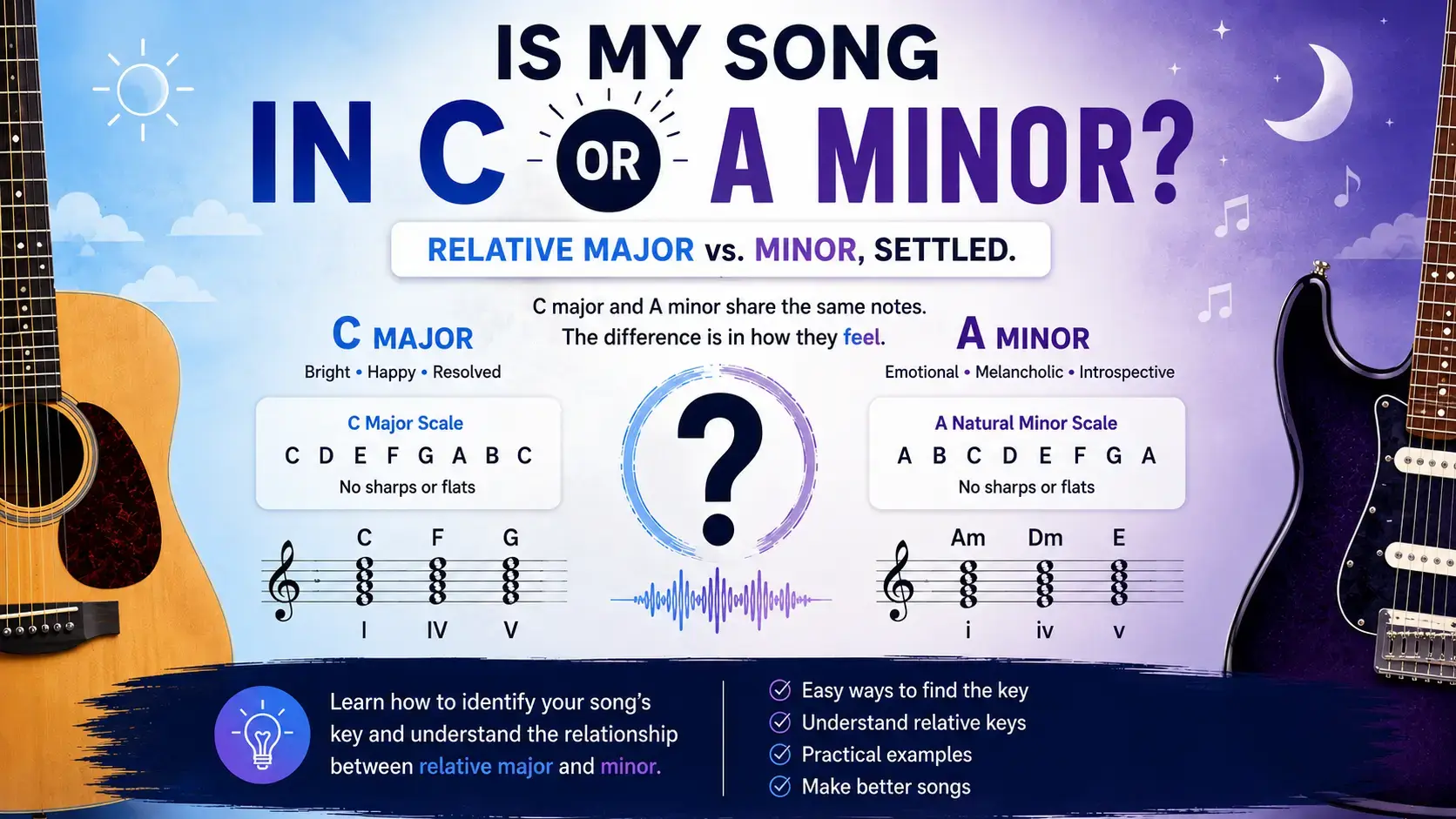
C major and A minor contain exactly the same seven notes and exactly the same seven chords. No chord list can tell them apart, because there is nothing in the list to tell apart. What separates them is which note the music treats as home.
So the question is never “which notes am I using?” It is “which chord does the song keep coming back to, and which one does it stop on?” If everything resolves to C, you are in C major. If everything resolves to Am, you are in A minor.
The 10-second version
Play the progression and stop dead on the last chord. If it sounds finished, that chord is your key. If it sounds like it still owes you something, keep going until you find the one that doesn’t.
Same Notes, Different Home
Every major key has a relative minor built on its 6th degree — three semitones below the major root. C major’s 6th degree is A, so A minor is its relative minor. Run both scales and you get the same seven letters starting in a different place:
C major
Filled square = the root. The other six notes are identical in both scales.
A natural minor
Filled square = the root. The other six notes are identical in both scales.
Because the note pool is identical, the two keys share a key signature — neither has any sharps or flats. That is why sheet music alone can’t answer this either: a blank key signature means C major or A minor, and you have to read the music to know which.
The same trick works in every key. Count down three semitones from any major root and you land on its relative minor: G major → E minor, D major → B minor, F major → D minor. The Circle of Fifths shows all 12 pairs at a glance, majors on the outer ring and their relative minors directly inside.
Why the Chord List Never Settles It
Build a chord on each note of C major and you get seven chords. Build a chord on each note of A natural minor and you get the same seven chords — only the numbering changes, because you started counting from a different note:
This is the whole reason the question exists. Somebody hands you Am – F – C – G and asks what key it is in. Nothing about those four chords is more “C major” than it is “A minor” — they belong to both. You need evidence from outside the chord inventory.
5 Tests That Actually Settle It
- 1
The last chord. The strongest single tell. Songs end at home, so whatever the final chord of the song — or of the chorus — is, that is almost always the key. Am at the end means A minor.
- 2
The first chord. Weaker, but usually right. A song that opens on C is probably in C major, though plenty of major-key songs open on the vi chord for effect. Never rely on this one alone.
- 3
The chord that feels like rest. Loop the progression and stop dead on each chord in turn. One will sound finished and the others will sound like they are waiting. The finished one is your tonic.
- 4
Where the melody lands. Chords can be ambiguous; the melody rarely is. Sing the last note of a phrase and find it on the neck — the vocal settles on the tonic far more often than on anything else.
- 5
The bass note under the resolution. If the bass drops to A when the phrase resolves, you are in A minor even if the chord above it is voiced loosely. The bass is the most reliable voice for hearing home.
Run all five and they normally agree. When they disagree — and with a four-chord loop they sometimes do — trust the melody and the bass over the chord order.
The E Chord Giveaway
There is one piece of hard evidence that settles this instantly when it shows up. In a minor key, the chord built on the 5th degree is usually played major rather than minor, by raising the 7th note of the scale a semitone. In A minor that raises G to G♯, which turns Em into E or E7.
G♯ does not exist in C major. So the moment an E or E7 turns up in a progression made of otherwise white-note chords, the major key is off the table — you are in A minor. That is why so many minor-key songs are full of E7 chords a diatonic chord chart says shouldn’t be there.
- E or E7 present
- A minor. The G♯ is a raised 7th — the harmonic minor move — and it only makes sense as the V chord pulling to Am.
- G7 pulling to C
- C major. G7 contains B and F, the leading tone and the 4th of C major, and it wants to land on C.
- Em, not E
- Inconclusive. Em is diatonic to both keys. It is the raised G♯ that proves something, not the E root.
- Bdim / Bm7♭5
- Inconclusive. It is vii° in C major and ii° in A minor — common in both, proof of neither.
- A stray D major
- Neither key, strictly: D major needs an F♯. It usually means the song has borrowed a chord, or that you are actually in G major.
Want that reasoning applied for you? The Key Finder flags every chord that falls outside the key it detected, so an E7 in a C-major progression shows up highlighted instead of quietly skewing the result.
Hear It: Four Chords, Two Keys
The last two examples below use the same four chords in the same cyclic order, rotated to start in a different place. Play them back to back — nothing changes except which chord the loop lands on, and that alone flips the key.
Press play to hear a progression strummed, or tap any single chord to hear it on its own.
Starts on C, ends on C, and the G before it is the V chord pulling back home. Nothing here points at A minor.
Ends on Am — and the E7 contains a G♯, a note that does not exist in C major. That single chord rules the major key out.
The same four chords as the loop below. Because the loop turns around on C, the ear hears C as home.
Identical chords, rotated. Now the loop lands on Am and the whole thing tilts minor. This is the genuinely ambiguous case — the melody decides it.
That fourth example is worth sitting with. Am – F – C – G is genuinely ambiguous on paper — it is the same loop as C – G – Am – F, and songs use both readings. When you hit a progression like that, the chords have given you everything they can. Go to the melody.
Loop your own progression →Every Relative Major / Minor Pair
The C / A minor confusion has eleven siblings. Every one of these pairs shares a note pool and a key signature, so every one of them raises the same question:
The shortcut, in both directions: down three semitones from a major root gives you its relative minor, and up three semitones from a minor root gives you its relative major.
Relative Minor vs Parallel Minor
One clarification that saves a lot of confusion: C major has two minor keys attached to it, and they are completely different things.
- Relative minor (A minor)
- Different root, same notes. Shares the key signature and all seven chords with C major. This is the one this article is about.
- Parallel minor (C minor)
- Same root, different notes. C minor carries three flats — B♭, E♭ and A♭ — so it shares almost nothing with C major except the letter C.
If someone says a song “goes to the minor,” ask which one. Borrowing a chord from the parallel minor — an Fm in a C major song, say — is a standard songwriting move and not a key change at all. Borrowing from the relative minor is impossible, because there is nothing there to borrow: the chords are already the same.
Common Mistakes to Avoid
- ✕Assuming the first chord is the key. It usually is, but opening on the vi chord is a standard move — the last chord is far more reliable.
- ✕Deciding by mood. "Sad means minor" fails constantly: plenty of minor-key songs are upbeat and plenty of major-key songs are melancholy. Judge by resolution, not by feel.
- ✕Reading the key signature and stopping there. No sharps or flats means C major OR A minor. The signature narrows it to two; it never picks one.
- ✕Ignoring the E / E7 evidence because it is "not in the key." The raised 7th is exactly what makes it evidence — it belongs to A minor and nowhere else nearby.
- ✕Confusing the relative minor with the parallel minor. C major’s relative minor is A minor; its parallel minor is C minor. They share a name and nothing else.
- ✕Forcing a verdict on a genuinely ambiguous loop. Some four-chord vamps really do sit between the two keys. Say so, and let the melody settle it.
Let the Key Finder Decide
Once you know what the evidence looks like, doing this by ear takes seconds. But when a progression is long, borrows chords, or genuinely sits between two keys, our Key Finder is faster and more honest than guessing.
Paste your chords and it scores all 24 major and minor keys and ranks them by confidence — so instead of being handed one answer, you see C major and A minor next to each other with their scores, which is exactly the information this question needs. It also gives a roman numeral for every chord in the detected key and highlights any chord that falls outside it, which is how the E7 tell surfaces without you having to look for it.
If what you have is a recording rather than a chord chart, the Song Key Finder detects the key from an uploaded audio file instead.
Try the Key Finder →Keep going
Related reading
All Guitar Tools
Free tools for every stage of your guitar journey.