
What Is a 12-Bar Blues?
A 12-bar blues is a chord progression that's 12 bars long, uses three chords, and repeats. That's it. One trip through the 12 bars is called a chorus, and a blues song is just chorus after chorus: the singer takes a few, someone solos over a few, and everyone comes back for the last one.
In the standard major-key blues, the three chords are the I, the IV and the V of the key, the first, fourth and fifth notes of the major scale. In E that's E7, A7 and B7. In A it's A7, D7 and E7. Three chords, and they're behind a huge chunk of blues, early rock and roll, and a lot of jam-session nights.
Why 12 bars, though? It matches how a lot of blues lyrics are written. A classic verse is three lines in an A-A-B pattern: you sing a line over bars 1–4, sing the same line again over bars 5–8 (now starting on the IV chord, so it lands differently), then answer it with a new line over bars 9–12. Four bars per line, three lines. Once you hear it that way, the form kinda counts itself.
The short version: 12 bars of 4/4, three dominant 7th chords (I7, IV7, V7), usually played with a shuffle feel, repeated until the song ends. Everything else on this page is a variation on that.
The 12-Bar Blues Chord Progression
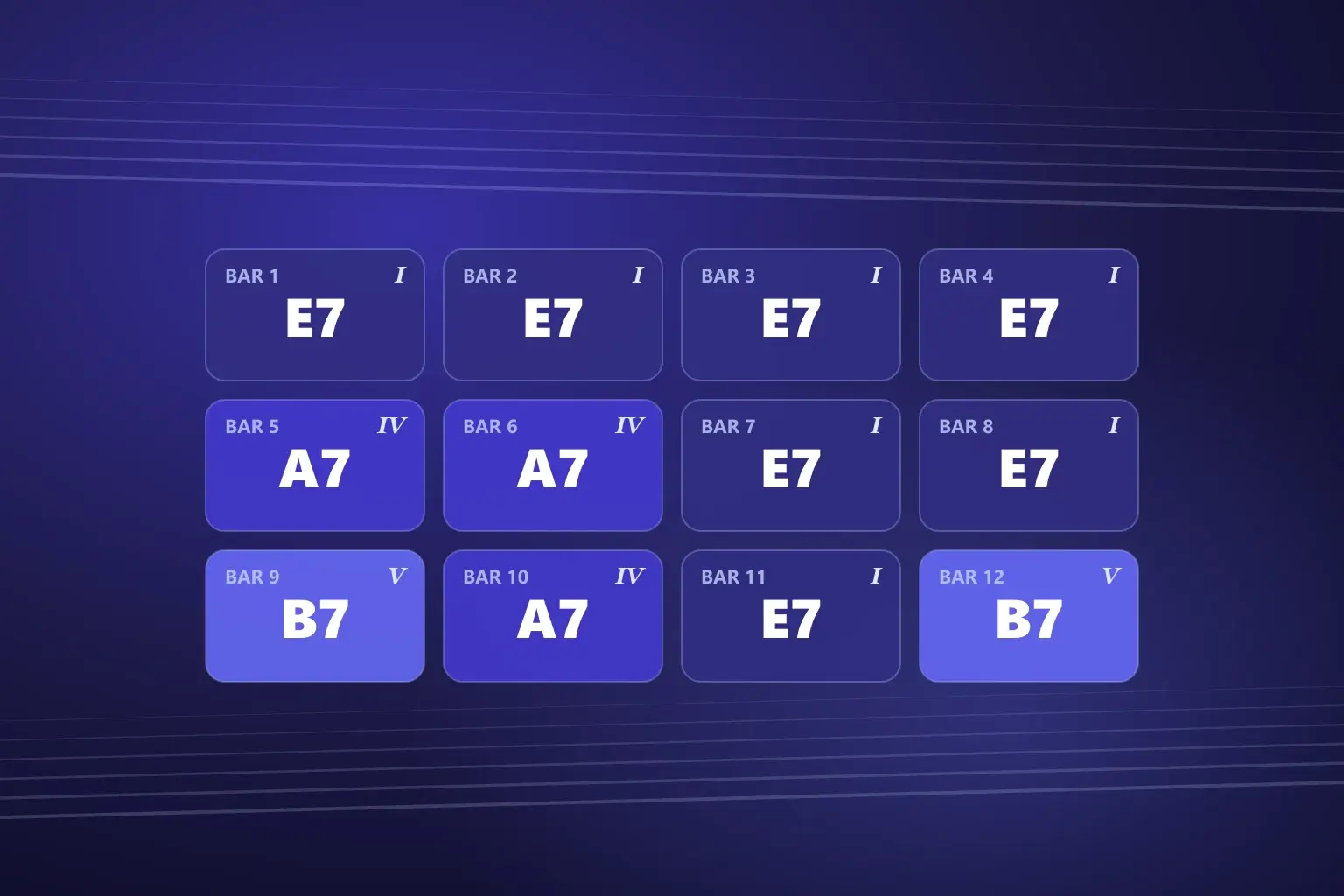
Here's the standard 12-bar blues chord progression, one chord per bar:
| Bars 1–4 | I7 | I7 | I7 | I7 |
|---|---|---|---|---|
| Bars 5–8 | IV7 | IV7 | I7 | I7 |
| Bars 9–12 | V7 | IV7 | I7 | V7 |
Read it like a sentence. Four bars at home on the I. Two bars away on the IV, then back home for two. Then the tension: up to the V, down to the IV, home to the I, and one last V in bar 12 that kicks you back to the top. That last bar is the turnaround, and we'll get to it.
Notice every chord is a dominant 7th, not a plain major chord. And this is the weird part, if you know some theory: in the key of E, the E7 has a D natural in it, and the E major scale doesn't. The I7 isn't really “in the key”. So is the theory wrong? Nope, the blues just doesn't care. That ♭7 on top of every chord is the sound. Swap the 7ths for plain E, A and B and it turns into a polite country song.
Hear It, Then Mess With It
Hit play and the player below runs one full chorus of the shuffle, with each bar lighting up as it goes. Flip the switches and play it again. They're the exact variations the next few sections talk about, so you can hear what each one changes instead of taking my word for it.
12-bar blues in E
One chorus is 48 beats, about 32 seconds at 90 BPM. Want it on loop with drums and bass? The blues backing track in E plays it until you stop it.
The Three Chords in E
These are the open-position shapes. Tap one to hear it. Each name links to its chord page, which has more ways to play it further up the neck.
In E, the B7 is the one that trips people up. It's a four-finger chord, and it shows up right when the form gets busy (bars 9 and 12). Practice the change from B7 to A7 on its own until it stops being a speed bump.
Quick Change vs. Slow Change
The progression above is the slow change: four full bars of the I before you move. The quick change sneaks the IV into bar 2, then goes straight back to the I for bars 3 and 4:
| Bar 1 | Bar 2 | Bar 3 | Bar 4 | |
|---|---|---|---|---|
| Slow change | I7 | I7 | I7 | I7 |
| Quick change | I7 | IV7 | I7 | I7 |
Bars 5–12 don't change at all. It's one bar, but it makes the opening feel like it's moving instead of sitting there. Set the player to Quick change and you'll hear the A7 pop up early.
This matters the moment you play with other people. Half the room playing the quick change while the other half sits on the I for four bars sounds about as good as you'd expect. So at a jam it's totally normal to ask “quick change or slow?” before the count-in. If nobody says, listen to bar 2 of the first chorus and follow the bass player.
There's one more common tweak: some versions play the V in bar 10 instead of the IV (so bars 9–10 are V–V instead of V–IV). It's less common, but it's worth knowing it exists so it doesn't throw you.
The Shuffle: How to Play 12-Bar Blues Rhythm
Strumming full 7th chords works, but the sound most people mean by “12-bar blues guitar” is the shuffle riff: two notes on the low strings, the root plus a note that rocks between the 5th and the 6th. Chuck Berry built a career on it. It's also way easier than it sounds.
The root is an open string, so only one finger moves: index on the 2nd fret for the 5th, ring finger on the 4th fret for the 6th. Here's one bar of each chord in E:
E7 (I7)
e|-------------------------|
B|-------------------------|
G|-------------------------|
D|-------------------------|
A|-2--2--4--4--2--2--4--4--|
E|-0--0--0--0--0--0--0--0--|
A7 (IV7)
e|-------------------------|
B|-------------------------|
G|-------------------------|
D|-2--2--4--4--2--2--4--4--|
A|-0--0--0--0--0--0--0--0--|
E|-------------------------|
B7 (V7)
e|-------------------------|
B|-------------------------|
G|-------------------------|
D|-4--4--6--6--4--4--6--6--|
A|-2--2--2--2--2--2--2--2--|
E|-------------------------|
That's the basic shuffle: 5th, 5th, 6th, 6th, repeated. (Those are notes of the scale, not fret numbers.) Switch the player's rhythm to Boogie (♭7) and the tabs above update with the pinky reach, 5–6–♭7–6. That extra note is the 7th of the chord, so the riff spells out the dominant 7th on its own. In E, the B7 bar has no open root, so the whole shape moves up: index on the A string at fret 2, and the top note stretches from fret 4 to 6 (and 7 for the ♭7). That's the one real stretch in the whole form.
What Makes It a Shuffle
The rhythm is swung. Each beat gets split into a long note and a short note, not two equal halves. How long the long one is depends on the tempo and the player, but triplets are the place to start. If you count “1-and-a, 2-and-a” (triplets), the shuffle plays the “1” and the “a” and skips the “and”. It sounds like DUM-da DUM-da, or a heartbeat that's in a hurry. If you play straight even eighths, it stops sounding like a blues and starts sounding like a march.
Here's a drummer's trick: say the triplets out loud first, then clap only the 1 and the “a”. Once your hands can do that, the guitar part is just moving the same feel to the strings.
- Palm muteRest the edge of your picking hand on the strings right by the bridge. You want a tight chug, not a ringing chord.
- All downstrokesPick every note down. It keeps the long-short feel even and gives the riff its push.
- Accent 2 and 4Lean a little harder on beats 2 and 4, where the snare would hit. That's where the groove lives.
- Two strings onlyAim for just the root and the moving note. Hitting a third string by accident muddies the whole thing.
Want to drill the feel without the chords? Run a shuffle groove on the Drum Tracks page and just chug the I-chord riff until it stops feeling like counting.
The Turnaround (Bars 11 and 12)
The turnaround is the little move at the end of the chorus that says “here we go again”. The simplest one is already in the form: the V chord in bar 12. It doesn't sound finished, and it's not supposed to. It pulls you back to the I at the top of the next chorus.
On the last chorus of a song you usually swap that V for the I (or play a little ending lick into it), so the song actually ends instead of hanging in the air. That's the player's Ending (I) setting.
Then there's the classic guitar turnaround lick: a note held on the high e string while a line on the B string walks down a half step at a time, from the ♭7 of the key to the 5th, and then you hit the V7. It's the sound of about a million blues records.
Turnaround in E → B7
e|-0--0--0--0--|-2--|
B|-3--2--1--0--|-0--|
G|-------------|-2--|
D|-------------|-1--|
A|-------------|-2--|
E|-------------|----|
Keep your fingers off the high e so it rings open the whole time. On the B string you play D, C♯, C, B: the ♭7, 6, ♭6 and 5 of E. Then strum B7. It follows the key you picked in the player above.
Played as four even beats, it fills bar 11, and the V7 lands in bar 12. Recordings usually swing it or play it in triplets. Get it clean and even first, and the swing comes later.
12-Bar Blues Chords in Every Key
E and A are the guitar keys, because the open strings line up with the roots. But you'll get called on to play it in G, C, or B♭ (horn players love B♭ and F), so here are the I, IV and V in all 12:
| Key | I7 | IV7 | V7 |
|---|---|---|---|
| C | C7 | F7 | G7 |
| D♭ | D♭7 | G♭7 | A♭7 |
| D | D7 | G7 | A7 |
| E♭ | E♭7 | A♭7 | B♭7 |
| E | E7 | A7 | B7 |
| F | F7 | B♭7 | C7 |
| F♯ | F♯7 | B7 | C♯7 |
| G | G7 | C7 | D7 |
| A♭ | A♭7 | D♭7 | E♭7 |
| A | A7 | D7 | E7 |
| B♭ | B♭7 | E♭7 | F7 |
| B | B7 | E7 | F♯7 |
You honestly don't need to memorize the table. There's a shape on the fretboard that finds all three chords for you. Put the root of the I on the low E string. The IV is on the A string at the same fret, and the V is two frets above that. In A (5th fret): A on the low E at 5, D on the A string at 5, E on the A string at 7. Slide the whole thing anywhere, and that's your blues in that key. The shuffle riff moves with it too: the root on the lower string, the 5th and 6th two and four frets up on the string above.
Need more chord shapes? The dominant 7th chords page has every root in three positions, including the barre shapes you'll want for keys like B♭ and F.
How to Solo Over a 12-Bar Blues
The good news is that one scale works over the whole progression: the blues scale of the key. It's the minor pentatonic plus one extra note, the ♭5.
- E blues scale
- E, G, A, B♭, B, D. In open position it's all open strings and the first three frets, which is a big reason so much blues is in E.
- A blues scale
- A, C, D, E♭, E, G. The classic box sits at the 5th fret, with the root under your first finger on the low E string.
Wait, a minor scale over major 7th chords? Shouldn't that clash? It does a little, and that rub is literally the blues. The ♭3 of the scale (G in E) grinds against the major 3rd of the chord (G♯). Bend the G up a hair toward G♯ and you get the “crying” note people mean when they say a guitar sounds bluesy.
Follow the Chords, Even a Little
The blues scale works everywhere, but if you never react to the chord changes, your solo can sound like it's floating over the band instead of playing with it. The easiest upgrade is to land on the 3rd of each chord when it arrives:
None of those 3rds are in the blues scale. That's why they work: they're the notes that say which chord you're on. The easy way to grab them is the E major pentatonic, which has the 3rds of the I and the IV built in. The V's 3rd isn't in it, so that one you aim for on purpose. Lots of blues players switch between the minor and major pentatonic in the same solo, minor for grit, major for sweetness.
One more neat thing: the D in the E blues scale is the ♭7 of E7, and the G is the ♭7 of A7. So the “minor” notes you're already playing are chord tones once the harmony moves. It's not a coincidence, it's why the whole thing works.
Phrase It Like the Lyrics
Remember the A-A-B lyric form? Steal it. Play a short lick over bars 1–4, play it again (or nearly) over bars 5–8 against the IV, then answer it with something different over bars 9–12. And leave gaps. A blues solo that never stops for breath is exhausting to listen to. The rests are part of the phrase.
The E blues scale page shows every position on the neck, and the pentatonic scale guide walks through the five boxes it's built from.
The Minor 12-Bar Blues
Same 12 bars, darker color. In a minor blues the I and IV become minor 7th chords, and bars 9–10 usually go to the ♭VI7 and then the V7 instead of V–IV:
That's A minor with the quick change in bar 2 (for the slow change, stay on Am7 for bars 1–4). Four chords in all: i7 (Am7), iv7 (Dm7), ♭VI7 (F7) and V7 (E7). That ♭VI-to-V drop in bars 9 and 10 is the move you hear in B.B. King's “The Thrill Is Gone” (in B minor, so Gmaj7 to F♯7 there). Notice the V stays a dominant 7th, with a G♯ in it. That raised note is what pulls you so hard back to Am.
For soloing, the A minor pentatonic and A blues scale fit like a glove here, with no major-3rd clash to manage. Minor blues is usually slower, too. Think 60–70 BPM, lots of space, lots of bends.
12-Bar Blues Songs to Learn
Once you know the form, you start hearing it everywhere, including in a lot of songs nobody files under “blues”. A few to listen to with the bar count running in your head:
- "Sweet Home Chicago"
- Robert Johnson's song, and one of the most-called tunes at blues jams. If you learn one 12-bar to play with strangers, make it this one.
- "Pride and Joy"
- Stevie Ray Vaughan. A driving shuffle played in E shapes, with the guitar tuned down a half step.
- "Johnny B. Goode"
- Chuck Berry. Under the famous intro, the rhythm part is the boogie shuffle from this page.
- "Hound Dog"
- Big Mama Thornton first, Elvis later. Listen for the A-A-B lyric lines.
- "Rock Around the Clock"
- Bill Haley & His Comets. Proof that early rock and roll is the 12-bar blues played faster.
- "Blue Suede Shoes"
- Carl Perkins. It opens with stop-time breaks before the band comes in on the full form.
- "Crossroads"
- Cream's take on Robert Johnson, a 12-bar in A built around a riff.
- "Kansas City"
- Another jam-session standard. Simple, and the form is easy to follow.
Here's a fun test. Put one on, count “ONE-two-three-four, TWO-two-three-four” up to twelve, and see if you land on the turnaround. If you do, you've basically learned the song's map already.
Practice It Over a Real Band
The 12-bar only really clicks when you play it with other instruments, because the whole point is keeping your place while everything moves around you. If you don't have a band handy, the Blues Backing Track is one. It's a looping 12-bar shuffle with drums, a boogie bass line and dominant 7th chords, in any of the 12 keys and at any tempo, with the blues scale drawn on the fretboard under the chart.
- 1Start slow, around 60–70 BPM, in E or A. Play the shuffle riff for a full chorus and count the bars out loud.
- 2Mute the backing track's guitar and be the rhythm guitarist. If you get lost, wait for the turnaround and jump back in at bar 1.
- 3Switch to soloing. Play only the blues scale for one chorus, then aim for the 3rd of each chord on the next one.
- 4Alternate: one chorus of rhythm, one chorus of lead. That's what a jam actually feels like.
- 5Change the key. If the fretboard shape from the every-key section works in G and C too, you own the form.
Prefer building the progression yourself, chord by chord? The Chord Progression Player has a 12-bar blues preset you can edit, too.
Jam over the blues in E →Keep practicing
Related reading
All Guitar Tools
Free tools for every stage of your guitar journey.